
There are few places in Ethiopia—and very few places anywhere in the world—where architecture, history, faith, and landscape come together as dramatically as Lalibela.
Hidden in the Ethiopian highlands are eleven medieval monolithic churches carved directly from the living rock.
These extraordinary churches form the UNESCO World Heritage Site known as the Rock-Hewn Churches of Lalibela, inscribed in 1978. UNESCO describes Lalibela as a major center of Ethiopian Christianity that remains a place of pilgrimage and devotion today.
For travelers interested in Ethiopian history, ancient architecture, religious heritage, and cultural tourism, Lalibela is one of the country’s essential destinations.
But the real experience begins when you stop looking at the churches simply as ancient monuments.
They are living places of worship.
What Makes Lalibela Unique?
The most remarkable thing about Lalibela is the way its churches were created.
They were not constructed by assembling stones into buildings in the conventional way.
Instead, enormous blocks of volcanic rock were carved downward and inward until the churches emerged from the surrounding rock.
UNESCO describes the churches as monolithic structures carved from living rock, with doors, windows, columns, floors, roofs, trenches, drainage channels, ceremonial passages, and underground spaces all created through this extraordinary process.
Imagine beginning with a massive block of rock.
Instead of building upward, the builders carved downward.
They removed the surrounding stone and gradually revealed a complete church.
The result is an architectural achievement that remains difficult to comprehend even after seeing photographs.
The History of Lalibela
The churches are traditionally associated with King Lalibela of the Zagwe dynasty, who ruled in the late 12th and early 13th centuries.
UNESCO explains that the city was developed as a symbolic “New Jerusalem”, particularly during a period when Christian pilgrimage to the Holy Land had become difficult.
The town was known as Roha before taking the name Lalibela.
The churches became the center of a sacred landscape designed around Ethiopian Christian pilgrimage.
This historical background is important because it explains why Lalibela is much more than a collection of unusual buildings.
The city was conceived as a spiritual destination.
Its architecture reflects that purpose.
The Eleven Rock-Hewn Churches
The Lalibela complex contains eleven principal monolithic churches.
They are generally organized into different groups, separated by the seasonal Jordan River channel and connected by trenches, tunnels, and passages.
Among the most important churches are:
Biete Medhane Alem
Meaning “House of the Saviour of the World,” Biete Medhane Alem is one of the most impressive structures in the northern group.
UNESCO identifies it as the largest of the Lalibela monolithic churches and notes its five aisles.
Its scale gives visitors an immediate sense of the ambition behind the entire Lalibela project.
Biete Mariam
The Church of Mary is another important church in the northern complex.
Its interior contains religious decoration and carved architectural details that demonstrate the artistic traditions of medieval Ethiopia.
Biete Amanuel
Located in the southeastern group, Biete Amanuel is known for its carefully carved architectural form.
Its appearance resembles a building constructed from stone blocks, yet it is actually part of the original rock mass.
That distinction is one of the things that makes Lalibela so extraordinary.
Biete Gabriel-Rafael
This church forms part of the southeastern complex and is connected to the surrounding network of trenches and passages.
The entire area should be understood as one interconnected sacred landscape rather than a collection of isolated buildings.
Biete Giyorgis — The Church of Saint George
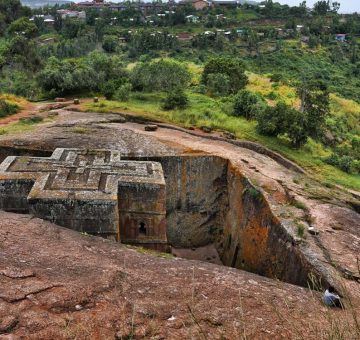
Perhaps the most famous church in Lalibela is Biete Giyorgis, or the Church of Saint George.
Its distinctive cross-shaped design has become one of the defining images of Ethiopia.
Unlike the churches grouped together in the main complexes, Biete Giyorgis stands separately in its own deep rock-cut courtyard.
The church was carved downward into the rock, leaving the structure surrounded by vertical walls.
Seeing it from above is one of the unforgettable moments of a Lalibela tour.
Lalibela Is a Living Religious Center
One of the biggest mistakes visitors can make is treating Lalibela as an archaeological site alone.
It is still a place of worship.
Pilgrims, priests, monks, and worshippers continue to use the churches.
UNESCO specifically emphasizes that Lalibela remains a place of pilgrimage and devotion and that its original religious function continues today.
This changes the way visitors should experience the site.
You are not simply walking through an abandoned medieval monument.
You are entering a living religious environment.
Visitors should therefore dress respectfully, follow local instructions, and be conscious when photographing worshippers or religious ceremonies.
Why a Local Guide Makes Lalibela Better
You can look at a rock-hewn church and immediately recognize that it is impressive.
But understanding why it was built, how it was carved, what its different architectural features represent, and how the churches connect to Ethiopian Christian traditions makes the experience much richer.
A knowledgeable local guide can explain:
- The history of the Zagwe dynasty
- King Lalibela and the development of the city
- The symbolism of the churches
- The different church complexes
- Ethiopian Christian traditions
- Local religious practices
- The architecture and engineering of the rock-hewn structures
- The relationship between Lalibela and pilgrimage
Without this context, visitors can easily leave having taken beautiful photographs without understanding the significance of what they saw.
Beyond the Churches
Although the rock-hewn churches are the main reason people visit Lalibela, the surrounding region deserves attention too.
Lalibela is situated in the Ethiopian highlands, surrounded by dramatic mountain scenery and rural landscapes.
The area provides opportunities to experience traditional village life, local food, Ethiopian hospitality, and the highland environment.
Traditional circular houses, known locally as Lasta tukuls, are also part of the cultural landscape surrounding the churches. UNESCO recognizes these traditional dwellings as part of the site’s broader cultural significance.
This combination of architecture, landscape, religion, and rural life makes Lalibela more than a single-day monument visit.
Lalibela During Religious Celebrations
Religious celebrations can make Lalibela particularly powerful.
Major Ethiopian Christian celebrations bring pilgrims and worshippers together around the churches.
Genna, Ethiopian Christmas, is especially significant, while Timkat, the Ethiopian celebration of Epiphany, is another major religious occasion across the country.
Traveling during major celebrations can provide a unique opportunity to witness living Ethiopian religious traditions.
However, these periods can also mean increased visitor numbers and more complicated logistics.
A well-planned itinerary is therefore important.
How Many Days Do You Need in Lalibela?
For travelers focused primarily on the churches, one full day can provide an introduction to the major complexes.
However, spending two or more days allows you to explore without rushing and include surrounding cultural and natural experiences.
Longer Ethiopia itineraries can combine Lalibela with destinations such as Gondar, Aksum, Simien, or other parts of Northern Ethiopia, depending on the route and current travel conditions.
Best Time to Visit Lalibela
Lalibela can be visited at different times of the year, but travelers should consider both weather and religious events when planning.
The Ethiopian highlands have seasonal differences in rainfall and road conditions.
Traveling with a local operator allows the itinerary to be adapted around the season, your interests, and the specific conditions at the time of travel.
If your main goal is to experience religious celebrations, planning around the Ethiopian calendar is especially important.
What Should You Wear in Lalibela?
Because Lalibela is a major religious destination, respectful clothing is appropriate.
Visitors entering churches should dress modestly and follow local instructions.
Comfortable walking shoes are also useful because exploring the churches involves uneven surfaces, stairs, trenches, and passages.
A good day of exploring Lalibela involves considerably more walking than the photographs might suggest.
Why Visit Lalibela?
Lalibela is ideal for travelers interested in:
- Ethiopian history
- Ancient architecture
- Religious heritage
- Rock-hewn churches
- Cultural tourism
- Photography
- Ethiopian Christianity
- Highland landscapes
- UNESCO World Heritage Sites
- Unique historical destinations
The churches are impressive because of their physical scale and engineering.
But what makes Lalibela truly special is that the achievement is still connected to living faith.
Experience Lalibela With Local Experts
A visit to Lalibela should be more than checking a UNESCO World Heritage Site off a list.
Take time to understand the history.
Walk through the rock-cut passages.
Look closely at the architecture.
Listen to the stories behind the churches.
Observe the religious traditions that continue around them.
And take time to experience the highland landscape beyond the main attractions.
That is when Lalibela becomes more than a photograph.
It becomes an experience.
Plan Your Lalibela Tour
Landscape Ethiopia Tours creates personalized Ethiopia tours combining Lalibela with other destinations according to your interests, schedule, and preferred travel experience.
Phone: +251 91 338 4298
Email: info@landscapeethiopiatour.com
Website: landscapeethiopiatour.com